

Unlocking inclusive education: Key concepts for success

Understanding collaboration
Collaboration is the ongoing teamwork between general educators, special educators, specialists, and families. It involves shared planning, decision-making, and responsibility to support student learning effectively. This collective effort ensures that all students, especially those with disabilities, receive comprehensive and consistent support tailored to their individual needs.
Key Characteristics
- Voluntary participation
- Parity among all participants
- Shared goals and accountability
- Mutual respect and trust
- Joint decision-making

Exploring co-teaching
Co-teaching occurs when a general educator and a special educator share instructional responsibility for a group of students in the same classroom. This model offers diverse instructional approaches and increased support, benefiting all students.
The Six Co-teaching Models
- One Teach, One Assist
- One Teach, One Observe
- Station Teaching
- Parallel Teaching
- Alternative Teaching
- Team Teaching
Key Characteristics
- Two credentialed professionals
- Shared physical space
- Joint planning and instruction
- Differentiated delivery
- Shared ownership of all students

The role of consultation
Consultation involves specialists, such as occupational therapists, physical therapists, speech therapists, counselors, and special education teachers, providing expert guidance to general educators on how to support students with disabilities. This invaluable expertise helps general educators implement effective strategies and interventions, enhancing inclusive practices within the classroom.
Key Characteristics
- Indirect service delivery
- Triadic relationship (consultant–consultee–student)
- Builds teacher capacity
- Voluntary and collaborative
- Data-driven and goal-oriented
Big Ideas in Collaboration, Co-Teaching & Consultation

Shared Responsibility
Effective inclusion is not the job of one teacher alone. It requires a team of professionals who collectively own the success of every student. Collaboration dismantles the "my kids / your kids" mentality and replaces it with "our students" (Villa, Thousand, & Nevin, 2008). When educators share ownership, outcomes improve for students with and without disabilities alike.

Equity and Access
All students, including those with disabilities and ESOL learners, have the right to access high-quality instruction in the least restrictive environment. Collaboration, co-teaching, and consultation are the mechanisms that make this right a reality in everyday classrooms. These practices transform the legal mandate into lived experience.

Professional Learning & Capacity Building
Consultation, in particular, builds the long-term capacity of general educators. When special educators serve as consultants, they help classroom teachers develop new skills and strategies that benefit future students as well (Dettmer, Thurston, Knackendoffel & Dyck, 2009). This creates a sustainable cycle of professional growth and improved instruction.

Student-Centered Outcomes
The ultimate purpose of collaboration, co-teaching, and consultation is to improve outcomes for students. Research consistently shows that co-taught classrooms, when implemented with fidelity, lead to higher academic achievement, greater social inclusion, and improved self-advocacy for students with disabilities (Murawski & Swanson, 2001).
Connecting the Three Concepts
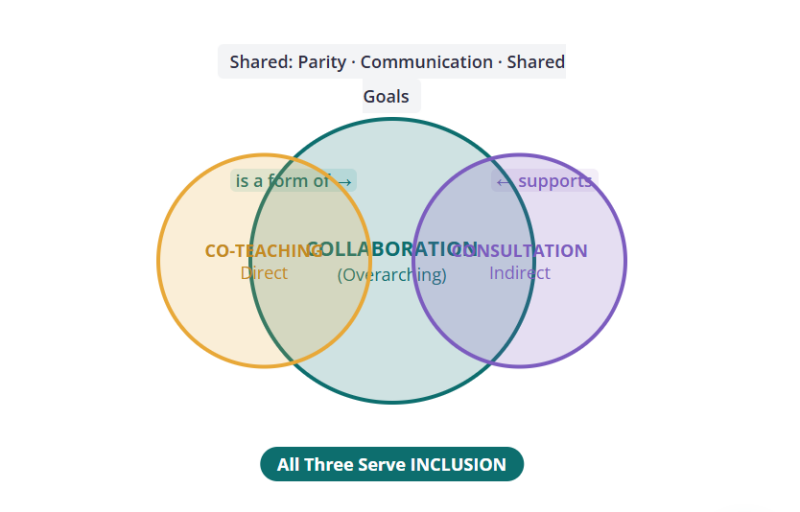
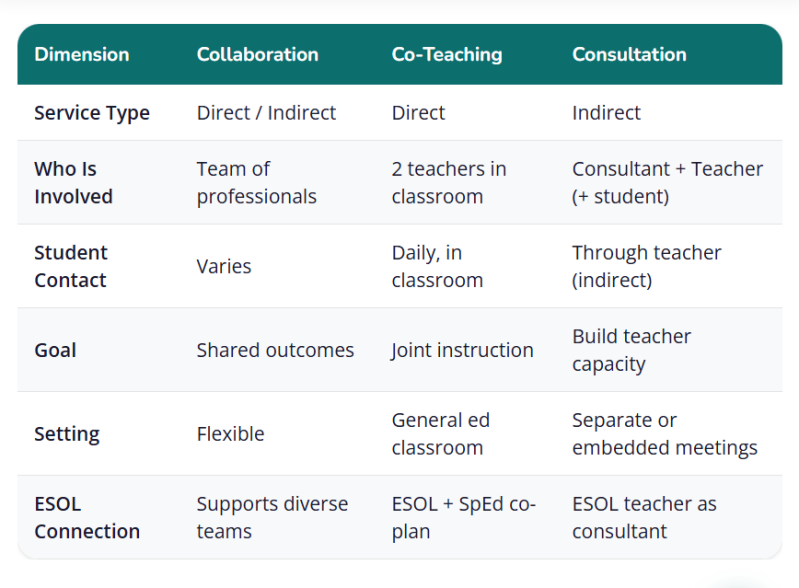
Collaboration, co-teaching, and consultation are interconnected elements of a professional partnership, all working towards the common goal of inclusion.
Common Challenges Teachers Face
-
Limited planning time
-
Not enough knowledge about disabilities
-
Difficulty meeting diverse needs
-
Behavior and self‑regulation challenges
-
Lack of access to specialists
-
Feeling unsupported or overwhelmed
How Collaboration, Co‑Teaching, and Consultation Solve These Challenges
-
Collaboration =shared responsibility
-
Co‑teaching = two teachers instead of one
-
Consultation = access to expert knowledge
-
Better behavior support
-
More access to grade‑level content
-
Teachers feel more confident and supported
Inclusion works best when teachers do not work alone. Collaboration builds teamwork and shared responsibility, co-teaching provides two educators in one classroom, and consultation brings expert knowledge directly to general education settings. Together, these practices solve significant challenges teachers face, creating classrooms where all students can succeed. This page aims to empower general education teachers, special education teachers, and administrators to embrace and implement these effective strategies, fostering truly inclusive learning environments.